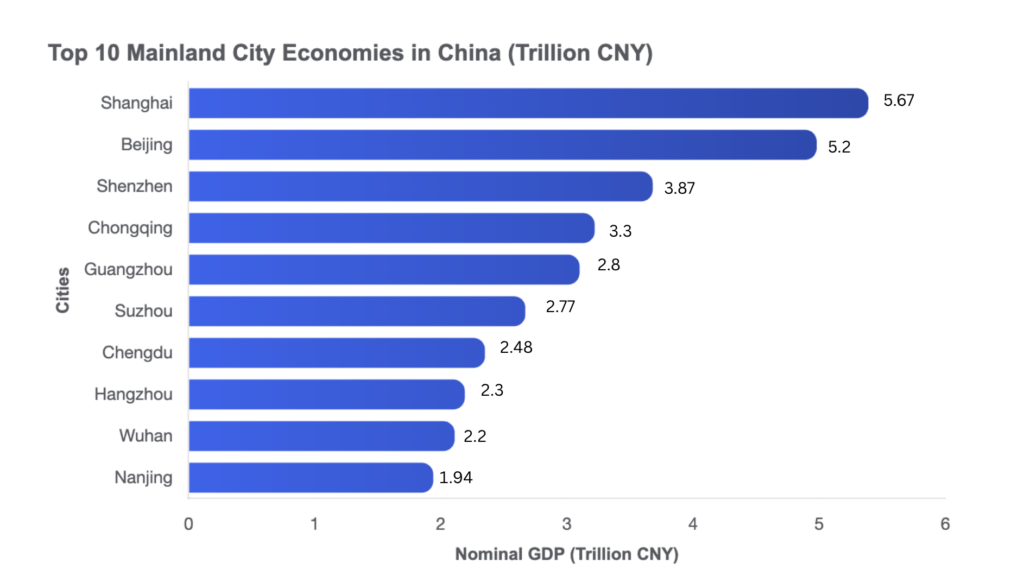
- China as a stand-alone is a leading powerhouse in the global economy, and this is largely due to the top 10 contributing agents across the nation. China’s 10 wealthiest cities have been pillars in China’s rapidly growing GDP, one generating over 5 trillion RMB GDP per year. These aren’t just cities—they hold the secrets to how urban development works. With a single city’s GDP often matching that of an entire European country, the following cities are the wealthiest in China according to the official reports of 2024 and 2025.
- In first place with the overall highest GDP of 5.67 trillion yuan: Shanghai. The star of China’s economy with a total output that exceeds Belgium’s GDP, hosting major Chinese firms such as China Baowu Steel, SAIC Motor, Bank of Communications, and COSCO Shipping. Shanghai is home to Tesla’s Gigafactory; which has a planned capacity of 2 million after expansion. As the nation’s financial center, Shanghai has the highest concentration of multinational companies’ regional headquarters, making it the largest regional headquarters hub in the country. The Shanghai Stock Exchange is the 3rd largest stock market in the world by market capitalization, and the Shanghai Port has been the world’s busiest port for container throughput for 12 consecutive years. Additionally, Shanghai ranks as the 3rd largest international shipping hub. With a population of nearly 25 million, Shanghai is the heartbeat of China’s economy.
- In second place with a GDP of 5.2 trillion yuan is Beijing, the capital. Serving as the political center of China, Beijing has a GDP larger than Argentina’s and headquarters China’s biggest state-owned enterprises. This city is home to State Grid and Sinopec, but also to tech giants like ByteDance, Baidu, and JD.com. Additionally, Beijing is home to over 22.5 million inhabitants. This powerful convergence of government, capital, and innovation makes Beijing the nation’s second-ranked economic powerhouse.
- In third place is Shenzhen with a GDP of 3.87 trillion yuan; a pioneer in China’s reform since 1978. Shenzhen has transformed from a small fishing village into a global tech metropolis. Culminating in a GDP nearly equivalent to that of Austria, Shenzhen has become China’s tech capital. The city is home to leading brands in the Chinese tech industry such as Huawei, Tencent, BYD, and DJI and is the epicenter of 5G, A.I., and biomedicine. Serving as the national leader in international patent applications, this city continues to attract young professionals with an average age of just 32. Home to over 13.5 million, Shenzhen is rooted in innovation, fast-paced growth, and setting a high standard for China’s high-tech industries.
- Ranked as number four with a GDP of 3.3 trillion yuan, Chongqing is Southwest China’s economic leader. With a GDP that surpasses that of Denmark, its automotive industry is massive. Companies such as Changan Auto and Lifan lead the market and Chongqing’s new energy vehicle production has exploded. Over one million units were produced within the last year alone. Because of the city’s strategic positioning on the Western Land-Sea New Passage and a population of over 30 million, it has proven itself a key player in China’s broader economic power.
- Guangzhou, with a GDP of 2.8 trillion yuan that surpasses the Czech Republic, holds the fifth place spot. In 2025, the city had a population of over 27.5 million people. Known for its strong manufacturing sectors, it is one of China’s oldest trade centers—but it is rapidly changing. Guangzhou is now shifting toward smart manufacturing, digital economy, and biopharma. It is home to automotive giant GAC Group and sees major growth in aerospace and drone production. Even though traditional automotive production has dropped by 18.2%, Guangzhou’s aerospace sector has jumped by 16.3%, and drone production has jumped to 2.9 times as many. Once it completes this transformation, Guangzhou could move its way up into the top four.
- Suzhou, number six on the list, is China’s “strongest prefecture-level city.” It has a GDP of 2.77 trillion yuan, comparable to Finland’s, and a growth rate of 6%, the fastest among the top ten. With e-commerce sales strategies at their peak, Suzhou capitalizes on housing major players like Ecovacs, the leader in home cleaning robots. It’s also the manufacturing base of fashion giant Bosideng and the only “trillion-level” consumption city that isn’t a provincial capital, and it’s proof that Suzhou’s manufacturing and foreign trade power is unstoppable. Additionally, its proximity to Shanghai allows Suzhou’s population of just over 7.7 million to benefit from industrial spillover and economic radiation from the neighboring metropolis; this serves as a kind of symbiotic relationship which supports their development.
- In the seventh spot is Chengdu; with a GDP of 2.48 trillion yuan that rivals Portugal’s and a population of over 10 million. The city has not only been popularized by its abundance of pandas, but also its massive industrial base in electronics, manufacturing, and healthcare. Its electronics industry alone is worth over a trillion RMB. Chengdu’s innovation hubs, like the Chengdu High-Tech Zone and Tianfu New Area, are extremely attractive global R&D centers. As a major player in China’s Western Development strategy, Chengdu’s international influence is growing and is steadily working its way toward becoming a global city.
- In eighth place, Hangzhou, not just famous for West Lake, is a digital powerhouse with a GDP that rivals Greece at 2.3 trillion yuan. This city, with a population of over 8.5 million, is also home to leading companies in tech and manufacturing such as Geely, NetEase, Unitree, and Alibaba. Similarly, Zhong Shanshan, the wealthiest man in China, lives in Hangzhou making it a high-profile city. Hangzhou is making waves in e-commerce, cloud computing, big data, and AI. With its stunning natural beauty and liberal business environment, Hangzhou is one of the ultimate spots for private enterprise.
- Wuhan, in ninth place, is Central China’s powerhouse. This city of nearly 9 million has displayed immense momentum, with a GDP of 2.2 trillion yuan surpassing that of New Zealand. Known as the gateway of nine provinces, it is a key player in the Yangtze River Economic Belt. Wuhan’s industries like optoelectronics, automotive, and biopharma are growing fast. It houses Dongfeng Motor, one of China’s top carmakers, and its optoelectronic cluster is now worth over a trillion RMB. They produce more than 60% of China’s optical fiber cables—and a quarter of the world’s total. Wuhan’s been going full throttle in new energy vehicles, and with its transition into high-end manufacturing, it is solidifying its place as Central China’s leader.
- Finally, number ten is Nanjing which hit a GDP of 1.94 trillion RMB in the first half of the year, putting it on par with Hungary. This city, full of history, is shifting gears fast. While it still has a strong hold in manufacturing, Nanjing is pushing hard into emerging industries like smart manufacturing and new energy vehicles. With 53 universities and over 800,000 students, it has one of the most competitive talent pools in the country. The city’s semiconductor and biopharma sectors are growing over 10% each year. To preserve its spot in the top ten, Nanjing needs to continue to grow and revise its economic plan as its competitor Ningbo quickly gains ground. With a population of over 10 million, Nanjing sits comfortably within the top ten wealthiest cities in China.
These ten cities behave as ten economic clusters with a combined wealth surpassing most countries. From state-owned giants in Beijing to cutting-edge tech firms in Shenzhen, or from Shanghai’s financial strength to Hangzhou’s e-commerce dominance, these cities are driving China’s dynamic economy. Not only do they act as wealth creators—but platforms for adventure and transformative tourism. Visiting these cities in person allows one to feel the palpable rapid pace of development. Anyone who visits China should consider coming to these hubs, if not for the impressive force at which they spearhead China’s economy, then for their lively, innovative identities.
Bibliography
“Economy.” Beijing.Gov.Cn, 2025. https://english.beijing.gov.cn/beijinginfo/facts/202601/t20260123_4458927.html.
“Guangzhou: Industry, Economics, and Policy – China Guide | Doing Business in China.” Www.China-Briefing.Com. Accessed July 29, 2026. https://www.china-briefing.com/doing-business-guide/china/where-to-invest/guangzhou-industry-economics-and-policy.
“Hangzhou, China Metro Area Population 1950-2024.” Macrotrends.Net, 2024. https://www.macrotrends.net/global-metrics/cities/20524/hangzhou/population.
Hangzhou’s GDP hits 2.3 trillion yuan in 2025, up 5.2. “Hangzhou’s GDP Hits 2.3 Trillion Yuan in 2025, Up 5.2%.” hangzhoufeel, 2025. https://www.ehangzhou.gov.cn/2026-01/22/c_296517.htm.
“Largest Cities by Population in China (2025) – Worldometer.” Worldometer, 2025. https://www.worldometers.info/population/largest-cities-in-china/.
macrotrends. “Beijing, China Metro Area Population 1950-2024.” Macrotrends.Net, 2024. https://www.macrotrends.net/global-metrics/cities/20464/beijing/population.
“Shenzhen Leads Major Cities with 5.5% GDP Growth on Tech Edge_Industrial News-Shenzhen Government Online.” Sz.Gov.Cn, 2026. https://www.sz.gov.cn/en_szgov/business/news/content/post_12640352.html.
Statista. “China: Population of Shanghai Municipality 2025| Statista,” 2025. https://www.statista.com/statistics/1133227/china-population-of-shanghai-municipality-administrative-area/?srsltid=AfmBOorA6j7DNH_MG92oy0rmwUrFoGYDkaJN82GbXbQO0Mn7a_fzKGhv.
Yang, Xudong. “Chongqing International Media Center.” iChongqing, May 14, 2026. https://www.ichongqing.info/2026/05/14/chongqing-outpaces-chinas-average-growth-during-14th-five-year-plan-amid-industrial-upgrading/.