China’s CPI Rises 0.9% in September as Non-Food Prices Increase
Beijing, October 14 —China’s Consumer Price Index (CPI) rose 0.9% year-on-year in September 2026, according to data released by the National Bureau of Statistics (NBS). Urban CPI increased 0.9%, while rural prices rose 0.8%. For the first nine months of 2026, CPI increased 0.9% year-on-year on average.
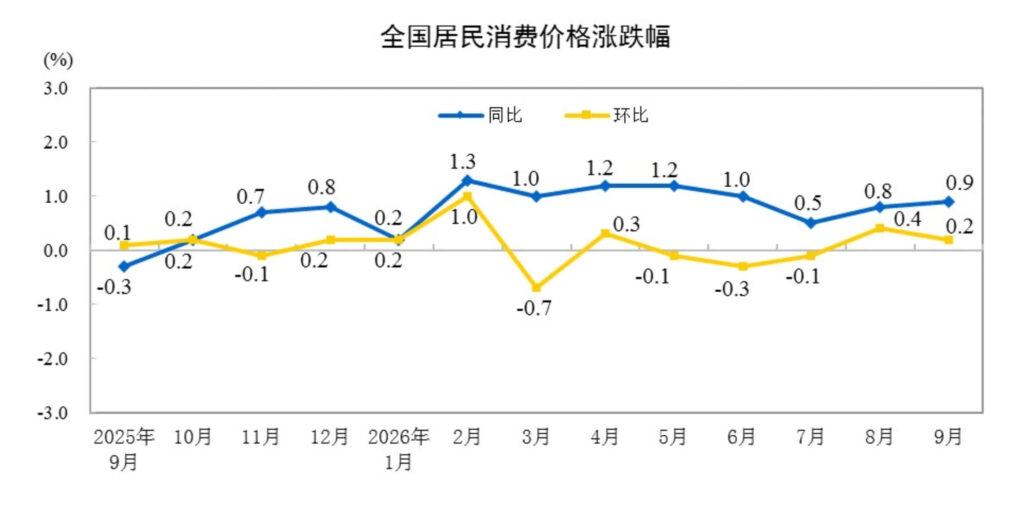
CPI change per month from 2025.09–2026.09, blue line is Year-on-Year, yellow line is Month-to-Month.
Food prices fell 1.7%, while non-food prices rose 1.5%. Consumer goods prices increased by 1.0%, and service prices rose 0.8%, reflecting higher prices in non-food categories despite continued declines in food prices.
On a month-over-month basis, CPI increased by 0.2%. Food prices rose 0.4%, while non-food prices increased by 0.2%. Consumer goods prices rose 0.5%, while service prices declined by 0.2%.
Category Highlights – Year-on-Year Changes:
Food, Tobacco & Dining: -0.9%
Clothing: +1.2%
Healthcare: +2.7%
Education, Culture & Entertainment: +1.4%
Other Goods & Services: +5.9%
Living Goods & Services: +0.2%
Transportation & Communication: +4.3%
Housing: -0.3%
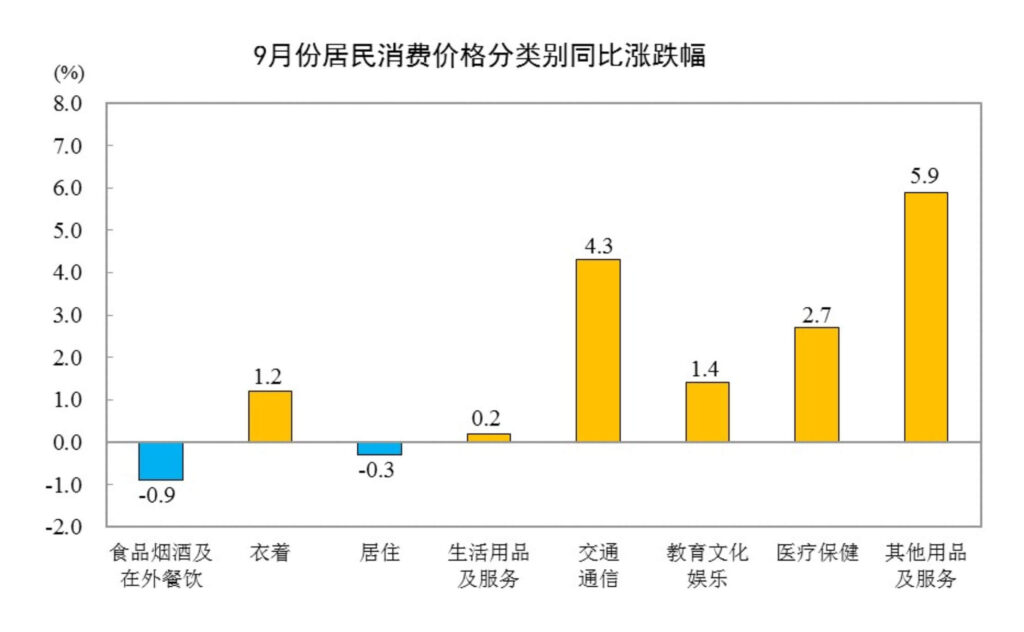
Consumption Categories in September: Food/Tobacco/Dining, Apparel, Housing, Household Goods & Services, Transportation/Communication, Education/Culture/Entertainment, Healthcare, Others.
Data Source: National Bureau of Statistics of China
https://www.stats.gov.cn/sj/zxfb/202610/t20261014_1965477.html
DeepSeek Nears RMB 100 Billion in New Funding Round
Hangzhou, October 6 — Chinese artificial intelligence company DeepSeek is reportedly nearing a new funding round of at least RMB 80 billion, potentially approaching RMB 100 billion, according to media reports. The reported amount is double its initial fundraising target of around RMB 50 billion.
The round reportedly values DeepSeek at approximately RMB 500 billion, although it remains unclear whether this refers to its pre-money or post-money valuation. CATL and Tencent Holdings are said to be among the largest investors. DeepSeek has not officially announced the completion of the round, and the reported figures remain unconfirmed.
DeepSeek gained international attention in January 2025 with the release of its R1 reasoning model, whose weights were made available under the MIT licence. Its launch highlighted the capabilities of Chinese AI models and drew attention to their development costs.The funding would give DeepSeek more capital to develop its AI models and expand computing capacity, both of which require substantial investment. The company is also reportedly considering a potential IPO, marking a possible next step in its growth.
China and EU Make Progress on Hybrid Vehicle Trade and Rare Earth Exports
Beijing, October 9 — China and the European Union reached a series of trade and investment understandings during their second round of consultations in Beijing on October 8–9, seeking to ease trade tensions and make bilateral economic ties more balanced. The meeting, co-chaired by Chinese Commerce Minister Wang Wentao and European Trade Commissioner Maroš Šefčovič, produced 16 agreed outcomes covering trade, investment, export controls and other issues.
Key outcomes included an understanding on hybrid vehicle trade, although they have emphasized different aspects of the arrangement. The EU said it could reduce Chinese hybrid and plug-in hybrid vehicle exports by more than half under its projections, while China said export quotas would be adjusted upward from 2025 levels and would not be lower than those granted to other import sources. China also agreed to continue facilitating export licence applications for rare earths and permanent magnets destined for Europe through a “green channel”, while the EU pledged to help resolve key licensing cases involving Chinese dual-use goods.
The talks also opened further discussions on reducing tariffs on certain goods and reviewing market access issues. Both sides agreed to continue technical dialogue on the EU’s Foreign Subsidies Regulation and to maintain communication, including a ministerial video conference in January 2027 and a third consultation meeting in March. While the outcomes signal progress in managing trade disputes, their impact will depend on how the agreed measures are implemented.
Huawei and Qualcomm Sign Multi-Year Patent Agreement
Shenzhen, October 5 — Huawei and Qualcomm have signed a multi-year patent licensing agreement covering 5G, computing, artificial intelligence and networking technologies. The agreement includes cross-licensing of the two companies’ patent portfolios, as well as Qualcomm’s purchase of certain Huawei patents registered in the United States. The patent purchase is subject to regulatory approval.
According to the companies’ joint announcement, the agreement is the first between Huawei and Qualcomm to include patent licensing for 5G technologies. Qualcomm said the deal recognizes Huawei’s continued innovation and intellectual property contributions, while Huawei acknowledged Qualcomm’s foundational contributions to communications technology.
The agreement follows a long-standing patent licensing relationship between the two companies. Huawei began licensing Qualcomm’s CDMA technology in 2001. The new arrangement expands the scope of their publicly announced licensing relationship to include 5G, computing, AI and networking, while introducing a separate purchase of certain Huawei U.S. patents.The agreement highlights continued intellectual property cooperation between two major technology companies despite ongoing U.S. restrictions on advanced semiconductor exports to China and broader technology competition.
From China Travel to China Haul: International Visitors Discover Chinese Tech
Beijing, October 9 – China’s National Day holiday is highlighting a growing trend among international visitors: combining travel with shopping for Chinese technology products.
According to Xinhua, 682,000 foreign nationals entered China during the October 1–7 holiday, up 5.4% year on year. In Shenzhen’s Huaqiangbei electronics market, foreign visitors showed strong interest in products including AI translators, smart glasses and robots. Nationwide, sales of smart glasses doubled year on year during the first six days of the holiday, according to the Ministry of Commerce.
The trend reflects growing international interest not only in China’s scenery and culture, but also in its technology products, manufacturing capabilities and consumer brands. Visa-free entry and improved tax-refund services are also helping make shopping more convenient for overseas travellers.
For inbound tourism operators, this creates opportunities to combine traditional sightseeing with visits to electronics markets, technology showrooms and innovation hubs. Such experiences can help visitors understand China’s technology ecosystem while discovering products firsthand.
For business travel providers, technology-focused tours could also serve as an entry point for deeper engagement with Chinese suppliers, manufacturers and emerging technology companies.